Hackthissite: Basic Challenge
I am currently pursuing a bachelor's degree in Electronic, Communication and Information Engineering at Pashchimanchal Campus(WRC), IOE, Tribhuvan University. I am passionate about Cybersecurity, Software Development and Data Science.
Overview
HackThisSite.org is an online platform that provides a legal and safe environment for individuals to improve their cyber security skills through a variety of challenges and Capture the Flag (CTF) events.
level 1
Vulnerability Description: Hardcoded password
On inspect there was a password in elements tab where the password was commented
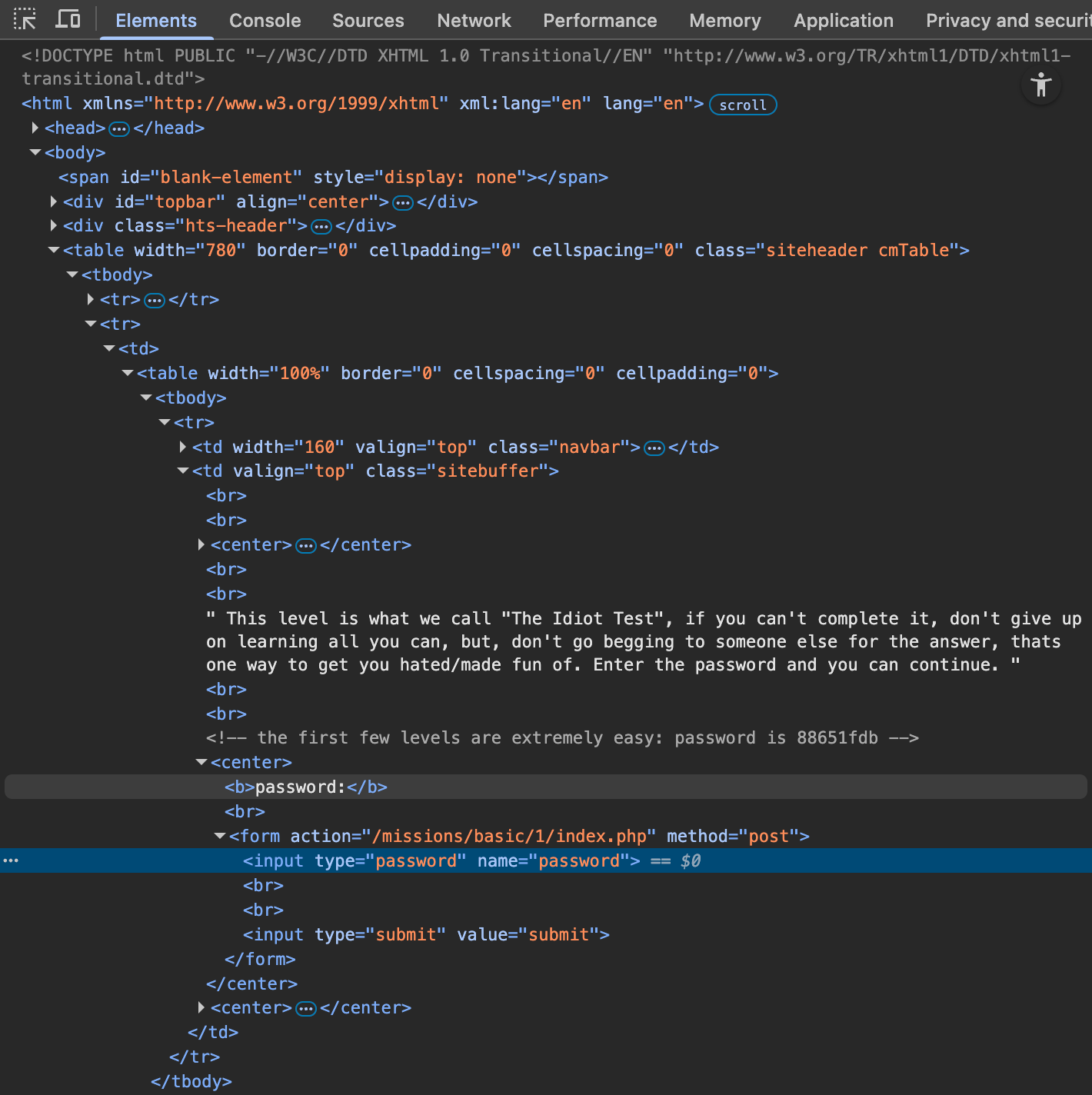
Solution
remove the comment section which contains such a credentials from the code.
Level 2
Vulnerability Description: No password file
Just entering with blank password solve the level 2


The potential error can be missing the password file, the file might not be uploaded
Error
If the script is poorly written, it might not properly handle the case where the password file is missing. for example:
the script might compare with empty string
(””)or nullIt doesn’t check for the valid password
A logic error in the script could allow empty or incorrect inputs to bypass authentication
- e.g.
if (user == password_from_file)without checking thepassword_from_fileis valid
- e.g.
Solution
To fix this issue and prevent unauthorized access, the following steps should be taken:
Ensure the Password File Exist:
Upload the password file to correct location on the server
Verify that the script can read the file
Add Error Handling
- Modify the script to handle case where the password file is missing or unreadable. For example
    $password_file = 'path/to/file'
    if (!file_exists($password_file)) {
        die("Error: Password file not found. Contact the administrator");
    }
    $real_password = trim(file_get_contents($password_file));
    if (!$real_password){
        die("Error: Password file is empty or corrupted.");
    }
Secure Password Storage
Store the password in hash and avoid using plan text which is insecure. You can use algorithms like
bcrypt,argon2Then convert the input password to the hash and compare with the hash files to identify if it is valid or not
Prevent Empty Input
- Add validation to ensure the user cannot submit an empty password.
    if (empty($_POST['password'])) {
        die('Error: Password file cannot be empty');
    }
Secure File Storage
If a file must be used, it must be outside the web root (e.g.
/var/secure/password.txt) to prevent direct access via the browser.Set strict file permission e.g
chmod 600 password.txtto ensure script can be read only
Test the script with varity of inputs.
Level 3
- Vulnerability Description: Location of password hidden in source code
We are already seeing the problem with this

This shows the potential vulnerability in the script. The issue likely stems from a Local File Inclusion(LFI) vulnerability
The presence of hidden input field name file with value password.php suggest that the script may use the file named password.php .
Error
Improper Password File Handling
The password file might be stored in a web-accessible directory, allowing direct access

Here while visiting https://www.hackthissite.org/missions/basic/3/password.php we simply get the password of the file
Solution
Remove and Sanitize the
fileParameterEliminate the
filehidden input from the form unless it’s absolutely necessary. Hardcode the password file path in the script to prevent user manipulationKeep the file outside the web root
$password_file="/secure/path/to/password.txt"If file parameter is required for some reason, validate and sanitize it strictly:
  $allowed_files = ['password.php']; // Whitelist allowed files
  $file = $_POST['file'];
  if (!in_array($file, $allowed_files)) {
      die("Error: Invalid file specified.");
  }
Prevent local File Inclusion:
Avoid using user input directly in file operations like
include,requireorfile_get_content$password_file = "/var/secure/password.txt"; // Not in web-accessible directory if (!file_exists($password_file)) { die("Error: Password file not found."); }
Level 4
Vulnerability Description: Hardcoded credentials within application
Here while inspecting we see a send password to Sam

While using
burpsuiteand intercepting the request we obtain theRequestHere, just modifying the
to=sam%40hackthissite.orgto our own email we get a mail providing the password for the site
Error
Insecure Direct Object Reference (IDOR)
Improper input validation
Flaw in Password Handling
Solution
Remove the Hardcode in
tofield- If the password has to go to the
sam@hackthissite.orgthen remove thetofield from the form, this prevent attackers from modifying the recipient email address.
- If the password has to go to the
Implement Authentication and Authorization
Require user to authenticate before they can trigger the password email functionality
  session_start();
  if (!isset($_SESSION['user_id']) || $_SESSION['user_id'] !== 'sam') {
      die("Error: Unauthorized access.");
  }
Validate and Sanitize Input
If
tofield is necessary then validate for e.g$allowed_emails = ["sam@hackthissite.org"]; $to = $_POST['to']; if (!in_array($to, $allowed_emails)) { die("Error: Invalid email address."); }
Level 5
The error in this challenge is same as the Level4
Level 6
- Vulnerability Description: Week encryption
Here,
| text | encrypted |
| Hello | hfnos |
| abcdefghijkll | acegikmoqsuwx |
Given 9d67hgg; to decrypt using ASII Table

We get for 9d67hgg; as,
Answer → 9c44dba4
Level 7
- Vulnerability Description: Command Injection
Here we have a Command Injection problem
The ; in the input section is just a command separator that executes multiple commands sequentially

This lead us to a new page where at the bottom we see the list of the files in that directory

Now while visiting to this k1kh31b1n55h.php like https://www.hackthissite.org/missions/basic/7/k1kh31b1n55h.php we obtain the password

Solution
Disable Directory Listing
Directory listing allows attackers to view the contents of a directory by accessing it via a browser or command
Manage Web Server Configuration
For Apache, add
Options -Indexesin the.htaccessfile or the main configuration file to disable directory indexing.For Nginx, ensure the
autoindexdirective is setoff
Secure File Storage
Store sensitive files outside the root
Use strong file permissions e.g.
chmod 600 fileAvoid hardcoding credentials in configuration files. Instead, use environment variables
Prevent Command Injection
Input Validation and Sanitization: Use allowlists for acceptable inputs rather than blocklists.
Use Safe APIs: Avoid using functions like exec(), system(), or eval() in code that processes user input.
Escape User Input: If commands must be executed, escape special characters
e.g.
$input = escapeshellarg($user_input);Web Application Firewall (WAF): Deploy to detect and block command injection
Level 8
- Vulnerability Description: Server-Side include (SSI) injection
On looking at the task and reading the prompt it looks something like SSL attack so I went to a website of OWAP where I sound some payloads and tried on them


Suprisingly, it worked and listed a series of file inside a parent directory
visiting the [https://www.hackthissite.org/missions/basic/9/](<https://www.hackthissite.org/missions/basic/9/>)au12ha38vc.php provide us with the password

Solution
Disable Server-Side Includes(SSL)
Disable SSL in the configuration file by removing or commenting out the Includes option in the Options directive:
  <Directory /var/www/>
      Options -Includes
  </Directory>
Similarly for nginx,
ssl off;
Sanitize and Validate User Input
Strict Input Validation: Implement an allowlist to accept only expected input patterns, rejecting anything containing SSI-like syntax (e.g., <!-- or #exec).
  if (preg_match('/<!--|-->|#exec|#include/i', $user_input)) {
      die("Invalid input detected");
  }
Escape Special Characters: Encode or escape user input to neutralize SSI directives before rendering it in HTML or passing it to the server.
Secure file and Directory Permission
- Change the mode of the files and folders using the command
chmod
- Change the mode of the files and folders using the command
Level 9
- Vulnerability Description: Server-Side include (SSI) injection
Here we get the credentials form level 8 by uploading
<!-- #exec cmd="../../9/" -->


We visited the link https://www.hackthissite.org/missions/basic/9/p91e283zc3.php and obtain password

Solution
The solution is all for level 8
Level 10
- Vulnerability Description: Incorrect implementation of Cookies
Viewing page source code was not use full in this level so I visited every tab of the inspect section

There was this level10_authorized in cookies section of Application tab. Initially, it has the value no but when I changed it to yes and refresh the page the challenge was complete
Error
The potential error here might be:
Lack of Server-Side Validation
Unprotected Cookies
Insecure Authorization Logic
Solution
Secure Server-Side Authorization
- Store authorization state in a server-side session or database, not in client-side cookies.
Secure Cookie with Cryptographic Protection
Use a cryptographic signature to ensure the cookie’s integrity. For example, append an HMAC (Hash-based Message Authentication Code) to the cookie value and verify it on the server.
  const cookie = require('cookie-signature');
  const secret = 'your-secret-key';
  // Sign the cookie
  res.cookie('level10_authorized', cookie.sign('yes', secret), { httpOnly: true });
  // Verify on server
  if (cookie.unsign(req.cookies.level10_authorized, secret) !== 'yes') {
      throw new Error('Invalid cookie');
  }
Set secure cookie attributes (
HttpOnly,Secure,Samesite)res.cookie('level10_authorized', 'yes', { httpOnly: true, secure: true, sameSite: 'Strict' });
Use secure session management
Use a session management framework (e.g., PHP’s session_start(), Express.js express-session, or Django sessions) to handle authentication and authorization.
Generate a random, unpredictable session ID and store it in a secure cookie.
If possible use the
JWTtoken in backend to get session ids.
Level 11
- Vulnerability Description: Unprotected .htaccess files
Here we need to enumerate the url using tools like gobuster , FFuF
we get this credentials in /e/l/t/o/n/DaAnswer

available was the password for /missions/basic/11/index.php

Conclusion
In conclusion, we found several vulnerabilities in the “Basic” web challenge from HackThisSite.org. These vulnerabilities include hardcoded passwords, no password file, location of the password file hidden in the source code, hardcoded credentials, weak encryption, and command injection. These vulnerabilities could potentially lead to a breach of confidentiality, integrity, and availability.
